
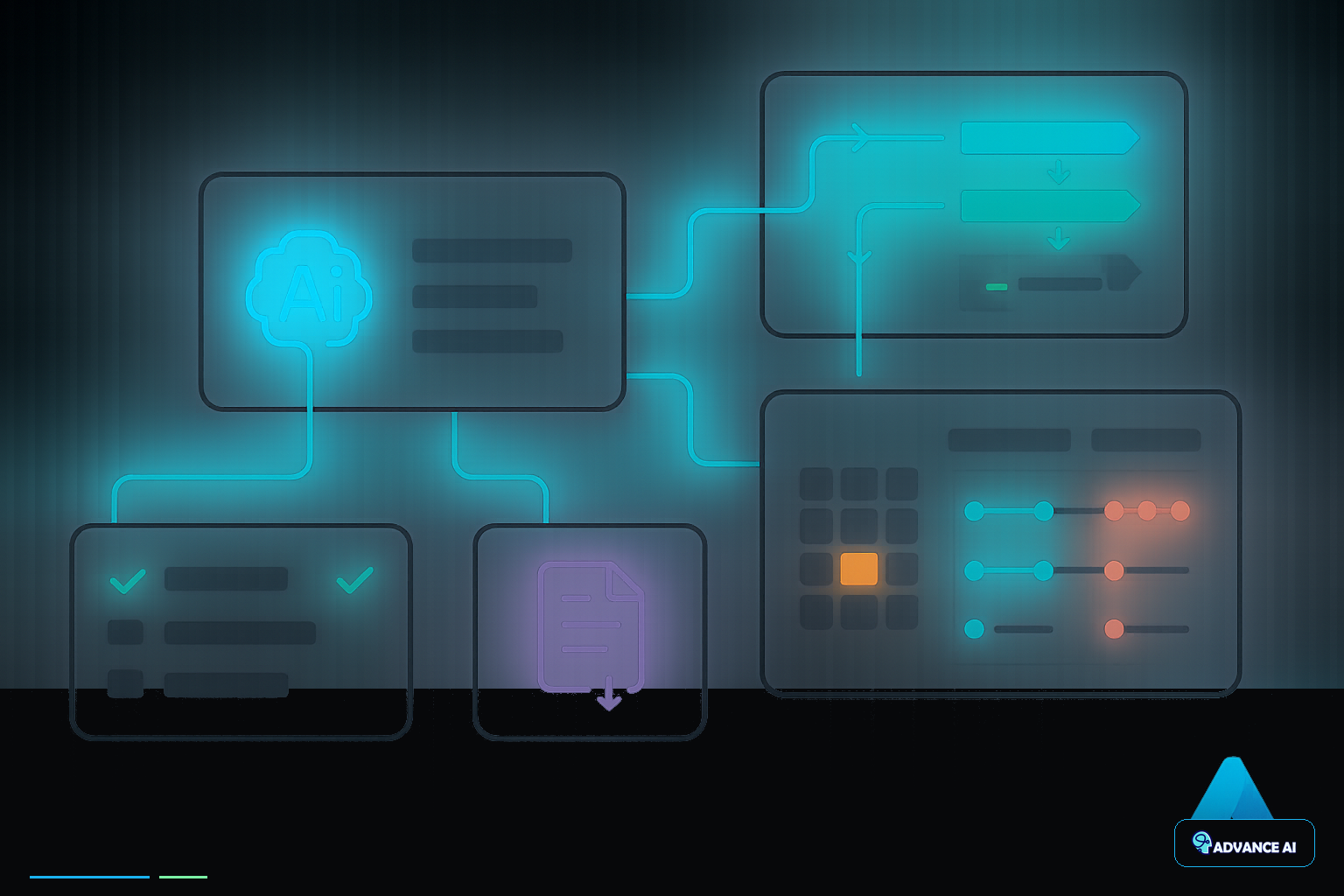
I've been building AI systems for businesses for years, and I can tell you this: we're standing at the edge of something fundamentally different. Google's recent push into agentic AI isn't just another product launch—it's the beginning of a new operating model where AI doesn't just help you work, it actually does the work.
As someone who's deployed AI agents across industries through AdvanceAI, I've seen firsthand how autonomous systems can transform operations. But Google's Gemini agents represent a shift that every small business owner needs to understand, whether you're running a local service company or scaling a digital startup.
What is Agentic AI and Why It Matters
Let's cut through the buzzwords. Agentic AI refers to AI systems that can operate autonomously to achieve specific goals without constant human oversight. Unlike traditional AI tools that respond to prompts, AI agents can plan, execute multi-step processes, make decisions, and even course-correct when things don't go as expected.
Think of it this way: if current AI is like having a really smart intern who needs detailed instructions for every task, agentic AI is like hiring an experienced professional who understands your business goals and figures out how to achieve them independently.
The practical difference is enormous. In our work at AdvanceAI, we've seen businesses move from spending hours on routine tasks to having those same processes run automatically in the background. Our MedoraMD platform, for instance, doesn't just help allergists manage patient data—it actively monitors treatment patterns, flags potential issues, and optimizes care protocols without physician intervention.
This matters for small businesses because you're typically resource-constrained. You can't afford to hire specialists for every function, but you also can't afford to have critical processes fall through the cracks. Agentic AI bridges that gap by giving you capabilities that were previously only available to large enterprises with dedicated teams.
Google's Gemini Agent Capabilities Overview
Google's Gemini agents are built on a foundation that's genuinely impressive from a technical standpoint. They can understand context across multiple interactions, maintain memory of previous conversations and decisions, and integrate with Google's ecosystem of business tools.
What sets Gemini agents apart is their ability to work across different modalities—text, images, code, and data—within a single workflow. This means an agent can analyze a spreadsheet, generate a report, create visualizations, and even draft follow-up emails based on the findings, all as part of one continuous process.
The agents can also interact with external APIs and services, which opens up possibilities for deep integration with your existing business systems. They're not confined to Google's walled garden, though they obviously work best within it.
From an operational perspective, what impresses me most is their ability to handle interruptions and context switching. Real business processes rarely run in straight lines—there are always exceptions, edge cases, and changing priorities. The Gemini agents I've tested show genuine adaptability in these situations.
The multimodal capabilities are particularly relevant for small businesses. You might have product photos that need descriptions, customer service tickets with attached documents, or sales data that needs to be turned into client presentations. Having an agent that can seamlessly work across all these formats eliminates a lot of the manual handoffs that slow down operations.
Real-World Applications for Small Businesses
Let me walk you through some concrete applications where I see immediate impact potential for small businesses, based on what we've learned deploying similar systems.
Customer service and support represents the most obvious starting point. An agentic AI system can handle initial customer inquiries, pull relevant account information, determine appropriate responses, and even escalate issues when they require human intervention. But unlike simple chatbots, these agents can maintain context across multiple touchpoints and actually resolve complex issues that span several interactions.
Sales and lead qualification is another area where the impact can be immediate. Agents can engage with website visitors, qualify leads based on your specific criteria, schedule meetings, and even conduct initial discovery calls. They don't just collect information—they can actively guide prospects through your sales process while adapting to different communication styles and objections.
Content creation and marketing automation becomes much more sophisticated with agentic AI. These systems can analyze your audience engagement patterns, generate content that aligns with successful posts, manage posting schedules across platforms, and even adjust messaging based on performance metrics. The key difference is they're making strategic decisions, not just executing templates.
Financial management and reporting offers huge efficiency gains. Agents can monitor cash flow, flag unusual expenses, generate financial reports, and even identify opportunities for cost savings or revenue optimization. They can work with your accounting software to ensure data accuracy while providing insights that most small business owners don't have time to extract manually.
Inventory and supply chain management becomes proactive rather than reactive. Agents can monitor stock levels, predict demand based on historical patterns and external factors, automatically reorder supplies, and even negotiate with suppliers within predefined parameters.
The real power emerges when you connect these applications. An agent managing your inventory can communicate with your marketing agent to promote overstocked items, while your customer service agent feeds insights to your product development processes. This level of integration used to require expensive enterprise software and dedicated IT teams.
Cost and Implementation Considerations
Here's where I'll give you the straight talk about costs, because the pricing models for agentic AI are still evolving and can catch businesses off guard.
Google's Gemini agents operate on usage-based pricing, which means costs scale with activity rather than seats. This can be advantageous for small businesses because you're not paying for unused capacity, but it also means your AI costs can vary significantly month to month based on business activity.
The real cost consideration isn't just the AI service itself—it's the time investment required to set up and optimize these systems. Unlike plug-and-play software, agents need to be trained on your specific business processes, integrated with your existing tools, and continuously refined based on performance.
From my experience deploying these systems, plan on spending 2-4 weeks getting an agent properly configured for any significant business process. This includes defining workflows, setting up integrations, testing edge cases, and training your team on how to work alongside the AI.
Integration costs can add up quickly if your business runs on multiple disconnected systems. Agents work best when they can access and update information across your entire tech stack. If you're still managing customer data in spreadsheets while running accounting in one system and inventory in another, you'll need to address those gaps before agentic AI can deliver its full potential.
Security and compliance requirements also factor into implementation costs. Depending on your industry, you may need additional safeguards, audit trails, or approval workflows that add complexity to agent deployment.
However, the ROI timeline is typically much faster than traditional automation projects. Because agents can handle exceptions and adapt to changing requirements, they start delivering value immediately rather than requiring perfect processes upfront.
Getting Started: First Steps for SMBs
If you're ready to explore agentic AI for your business, start with process mapping rather than technology evaluation. Identify 2-3 business processes that are currently eating up disproportionate time relative to their complexity. Look for tasks that involve multiple steps, require gathering information from different sources, or need to be performed consistently but with some variation based on context.
Good candidates are processes where you find yourself thinking, "I wish I could just tell someone what I need and have them figure out the details." Customer onboarding, invoice processing, content creation workflows, and routine research tasks typically fit this profile.
Start with a single, well-defined process rather than trying to automate everything at once. Choose something important enough that success will have visible impact, but not so critical that failure would damage your business operations.
Document your current process in detail, including exception cases and decision points. Agents need clear guidelines about when to proceed autonomously and when to escalate to humans. The time you spend on this documentation will determine how smoothly implementation goes.
Set up proper measurement frameworks before deployment. Define what success looks like in terms of time saved, error reduction, or customer satisfaction improvement. Agentic AI systems improve over time, but only if you're tracking the right metrics and feeding insights back into their training.
Plan your integration strategy early. Identify which systems the agent will need to access and what permissions or API connections you'll need to establish. Many implementation delays come from underestimating the technical requirements for system integration.
Start small, measure results, and scale gradually. The businesses that get the most value from agentic AI are those that treat it as an ongoing operational improvement rather than a one-time technology deployment.
Future Outlook and Strategic Planning
Looking ahead, the trajectory is clear: agentic AI will become as fundamental to business operations as email and cloud computing are today. The question isn't whether your competitors will adopt these technologies, but how quickly and effectively they'll integrate them into their operations.
Google's investment in Gemini agents signals a broader industry shift toward AI that can handle complete workflows rather than individual tasks. This means the competitive advantage will go to businesses that can successfully orchestrate multiple agents working together, rather than those that simply deploy individual AI tools.
The integration between AI agents and business intelligence will deepen significantly. Future systems won't just execute predefined processes—they'll analyze performance data, identify optimization opportunities, and even suggest new business strategies based on patterns they detect.
We're also seeing the emergence of specialized agent marketplaces where businesses can access pre-trained agents for specific industries or functions. This will lower the barrier to entry for small businesses that want sophisticated AI capabilities without the development overhead.
The regulatory landscape around autonomous AI systems is still developing, but businesses that establish strong governance frameworks now will be better positioned as compliance requirements evolve.
From a strategic planning perspective, start thinking about agentic AI as digital workforce expansion rather than automation technology. Consider which roles in your organization could be augmented or replaced by AI agents, and how that might change your hiring and training priorities over the next 3-5 years.
The businesses that thrive in this environment will be those that can effectively blend human creativity and judgment with AI efficiency and consistency. This isn't about replacing people—it's about amplifying human capabilities and freeing up mental bandwidth for the work that actually requires human insight.
As we've learned through our deployment experience at AdvanceAI, the most successful implementations happen when business owners view AI agents as team members that need proper onboarding, clear responsibilities, and ongoing performance management. The technology is ready—the question is whether your business processes and mindset are prepared to make the most of it.
Action Item: This week, identify one repetitive process in your business that takes 2+ hours per week and involves at least 3 decision points. Document the current workflow step-by-step, including what information you need at each stage and what could go wrong. This exercise will give you a concrete starting point for evaluating whether agentic AI could deliver meaningful impact for your specific situation.